

OYSTER baskets that improve farming efficiency while growing a higher quality product are helping an Australian company penetrate international markets. (Text & Video)
 SEAPA has been making its innovative baskets in Adelaide, South Australia, since 1998 but has doubled its size in the past 12 months on the back of strong sales into the US and France.
Originally designed for adjustable long line oyster farming, in the past three years new models of the baskets have been adapted so they can be retrofitted to different farming techniques, such as the French method or the increasingly prevalent sub-tidal technique in deeper waters.
The company has now established offices in the United States, Ireland, France, and Japan and has local staff in each region. It also has clients in Mexico, Canada and Portugal.
 SEAPA’s International Business Development Manager Andy Will said the success in the United States and France was the result of more than a decade in each region, working with local farmers to establish a foothold.
“There’s been a lot of time and investment put in to get us to this point and we’re only just scratching the surface in some of these large markets,” he said.
“We’ve been in the US since 2003 – we made a lot of mistakes, there’s no overnight success there but now we’re getting to the point where we are actually at the table.
“France is very similar. We’re just starting to see the potential in those markets.”
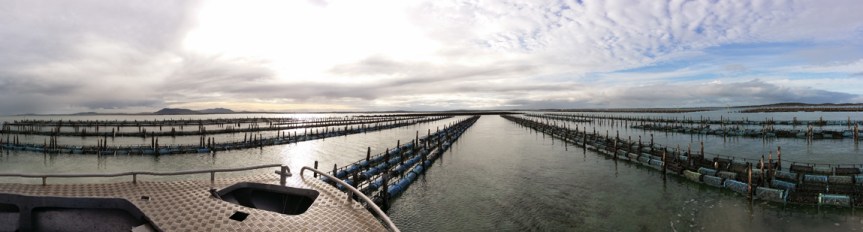
The SEAPA baskets are attached to long lines in rows similar to a vineyard and utilise the natural currents of the ocean and tidal movements to gently rock the baskets, moving the oysters around inside.
Will said the SEAPA baskets relied on the natural movement of the ocean to develop quality oysters, particularly for the premium half-shell market.
“The oysters like to move – that leads to a nice cup shape to the shell and it builds up the muscle and the more muscle the better,” he said.
“What we sell is a system that we would argue allows farmers to produce the highest quality oyster possible with as much efficiency built into that process.
“France is definitely a good example, the feedback we’ve been having is that purely based on the quality of the oyster that’s coming out, for every dozen oysters they are selling, they are getting one Euro extra and have won some gold medals at the Paris Food Show.”
SEAPA sells about 120,000 – 150,000 baskets a year, which are manufactured in Adelaide by its parent company Garon Plastics.
“The business has essentially doubled in size in the past 12 months, we’re looking at another 35-40 per cent this year,” Will said.
“We’ve had a dramatic shift. Up until then 25 percent of our market was export and 75 percent was in Australia – primarily in South Australia and Tasmania. Now it’s about 75 percent export – a big chunk of that is into the US – and 25 percent domestic.”
 China produces about two thirds of the world’s 3 million tonnes of oysters a year. However, the Chinese oysters are generally tinned or used in cooking and not served in a half-shell at the premium end of the market.
Of the other 1 million tonnes, the United States and Japan produce about 25 per cent each and France about 10-15 per cent. Australia produces about 10,000 – 15,000 tonnes of oysters each year, less than one per cent of the world market.
The adjustable long line oyster farming method was developed on South Australia’s Eyre Peninsula and is now being used to produce premium oysters throughout the world.
Oysters Australia President Bruce Zippel said this had been partly driven by a gradual shift in demand in the western world from bulk meat oyster products to premium half-shell oysters.
“Australians are very good at developing technologies and then selling it to their competitors, we’ve seen it in agriculture, wine and the oyster industry is no different,” he said.
“The oyster industry here probably has the best growing technology in the world as far as the half shell premium market goes.
“It is an expensive system compared to other traditional systems but the fact that these guys (SEAPA) have been growing their sales around the world is a good sign that the technology is being picked up.”
Will said having a “hand in glove” relationship with its manufacturer in South Australia had allowed SEAPA to maintain quality control and constantly improve its products.
“For every product that goes through the factory we increase the knowledge of the team, which directly gets reinvested in the next product and the next system,” he said.
“Everybody talks about being innovative but you’ve got to be building it for it to ring true.
“Quality is non-negotiable for us and we feel people are paying for quality in buying our product so we have to have a product that is going to do what it says and do it for a long time.”
Employing local staff overseas and having stock close to market were also crucial factors in the export growth.
“An Irish farmer wants to speak to a guy with an Irish accent,” Will said.
“Americans love Australians but they want to do business with someone who is American – France is the same.
“It doesn’t work for us just to go in and say this is the Australian way of doing business because people will put up with that to a point but if you want to do the long-term play we’ve got to invest in understanding them rather than the other way around.”
Discover more from Basil & Salt Living | FLAVORA
Subscribe to get the latest posts sent to your email.
